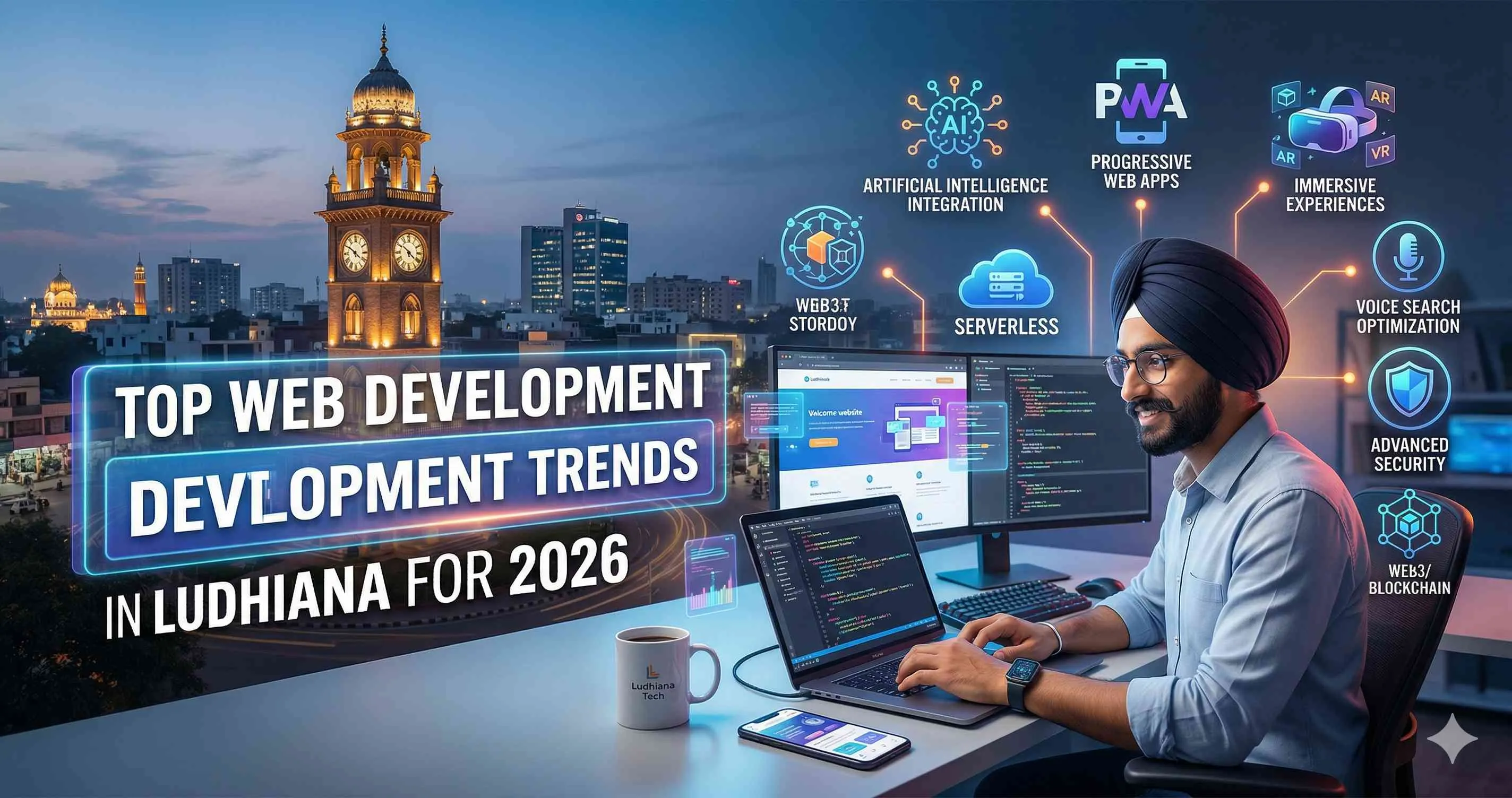
Top Web Development Trends in Ludhiana for 2026: The Ultimate Business Guide
Ludhiana, historically revered as the 'Manchester of India' for its dominance in textile manufacturing, bicycles, and auto components, is currently undergoing a monumental digital metamorphosis. As we navigate through 2026, the city is no longer just an industrial powerhouse; it is rapidly emerging as a formidable tech hub in North India. Spurred by the Punjab Industrial and Business Development Policy 2026, which heavily incentivizes IT, R&D, and digital infrastructure, local enterprises are completely reimagining their digital footprints. In this highly competitive era, understanding and implementing the latest website trends Ludhiana has to offer is no longer optional—it is a critical imperative for business survival and global scalability.
From legacy manufacturing units migrating their operations to the cloud, to modern startups building decentralized applications, the ecosystem of web development Ludhiana is experiencing an unprecedented evolution. Consumers and B2B clients in 2026 demand lightning-fast performance, immersive interfaces, and hyper-personalized interactions. This comprehensive guide delves deep into the top web development trends that are reshaping the digital and economic landscape of Ludhiana in 2026.
The Digital Transformation of Ludhiana's Industrial Landscape
To truly grasp the trajectory of web development in the region, one must first understand the underlying economic catalysts. The year 2026 has brought significant regulatory and infrastructural shifts to Punjab. With the state government pushing for the digitalization of MSMEs and extending subsidies for technology adoption, traditional businesses are finally breaking away from outdated legacy systems. For decades, Ludhiana's core sectors—hosiery, machine tools, and cycle manufacturing—relied heavily on physical supply chains and rudimentary static websites. Today, these same industries require complex, dynamic B2B portals, robust e-commerce platforms, and real-time inventory management systems.
This shift has fueled a massive demand for professional web development agencies in Ludhiana capable of delivering enterprise-grade solutions. The focus has entirely shifted from 'having a website' to 'building a digital product' that actively drives revenue, automates workflows, and provides secure international gateways for export businesses.
1. AI-First Development and Agentic Web Interfaces
Artificial Intelligence has transcended its role as a mere buzzword and is now the foundational pillar of modern web development. In 2026, the integration of AI is not just about adding a chatbot widget; it is about building 'Agentic Web Interfaces.' These are intelligent, autonomous agents embedded directly into the website's architecture that can complete complex workflows on behalf of the user.
Automating B2B and B2C Interactions
For Ludhiana's export and manufacturing sectors, AI-first web development is revolutionary. Imagine an international buyer visiting a local auto parts manufacturer's portal. Instead of manually navigating through thousands of SKUs, an embedded AI agent understands the buyer's query in natural language, analyzes their past purchase history, cross-references current warehouse inventory, and instantly generates a customized wholesale quotation. Furthermore, developers in Ludhiana are heavily utilizing AI-assisted coding tools (like GitHub Copilot and advanced LLMs) to write, debug, and deploy code faster, significantly reducing the time-to-market for complex web applications.
2. Progressive Web Apps (PWAs) as the Default Standard
The debate between building a native mobile app versus a responsive website has effectively been settled by the universal adoption of Progressive Web Apps (PWAs). In 2026, PWAs are the gold standard for delivering mobile experiences. They combine the broad reach of the web with the high performance and offline capabilities of native mobile applications.
Bridging the Gap for Local Retailers
Why is this specific to Ludhiana? The city boasts a massive retail and wholesale textile market. Developing dedicated iOS and Android apps for every local brand is cost-prohibitive and suffers from 'app fatigue'—users simply do not want to download another app. PWAs solve this by allowing users to 'install' the website directly to their home screen from the browser. They offer push notifications, lightning-fast load times, and offline access. For a Ludhiana-based fashion retailer, a PWA ensures that a customer can browse catalogs even with spotty internet connectivity, leading to higher engagement and drastically improved conversion rates.
3. Server-Side Rendering (SSR) and Edge Computing
Performance-first design is non-negotiable in 2026. Google's ever-evolving Core Web Vitals heavily penalize slow-loading websites, directly impacting search engine rankings and organic traffic. To combat this, the web development community in Ludhiana has aggressively pivoted towards Server-Side Rendering (SSR) and Edge Computing, leveraging modern meta-frameworks like Next.js and Nuxt.js.
Global Reach with Zero Latency
Traditional Client-Side Rendering (CSR) requires the user's browser to download and execute heavy JavaScript files before displaying the page. SSR, conversely, pre-renders the HTML on the server, serving a fully formed page to the user instantly. When combined with Edge Computing—where the website's data is processed at a server node geographically closest to the user—the results are phenomenal. A Ludhiana bicycle exporter targeting markets in Europe or North America can now ensure their high-resolution product catalogs load in milliseconds, establishing instant credibility and trust with overseas buyers.
4. Headless CMS and Composable Architectures
The monolithic architectures of the past, where the frontend design and the backend database were tightly coupled (like traditional WordPress setups), are making way for Headless Content Management Systems (CMS) and Composable Architectures. This is one of the most critical website trends Ludhiana developers are implementing for scaling businesses.
Omnichannel Content Delivery
A Headless CMS separates the content repository (the body) from the presentation layer (the head). Content is created and stored once, and then delivered via APIs to any device—be it a smartwatch, a mobile app, a digital billboard in a Ludhiana mall, or a traditional web browser. This composable approach allows businesses to select 'best-of-breed' technologies. For instance, a local business might use Shopify for its robust e-commerce backend, Contentful for managing blog content, and React for a lightning-fast custom frontend. This modularity reduces technical debt and allows businesses to pivot their digital strategies without rebuilding their entire infrastructure.
5. 3D Web Design and Immersive UI/UX
As internet bandwidths have increased and browser capabilities have matured, the use of 3D elements, WebGL, and Three.js has skyrocketed. Web design is moving away from flat, static images toward highly interactive, immersive 3D experiences.
Showcasing Ludhiana's Engineering Prowess
This trend is particularly lucrative for Ludhiana's heavy machinery and automotive components sectors. Instead of uploading 2D photographs of a complex CNC machine, manufacturers are integrating interactive 3D models into their websites. Prospective buyers can rotate the machine, zoom in on intricate components, and view animated demonstrations of the machinery in action directly within their web browser. This level of interactive product visualization significantly shortens the B2B sales cycle, as it provides a near-physical understanding of the product without requiring an immediate factory visit.
6. Advanced Cybersecurity and Zero-Trust Architectures
With the exponential growth in digital transactions and international trade originating from Ludhiana, cybersecurity has transitioned from an IT afterthought to a primary business objective. The web development landscape in 2026 is heavily focused on 'Security by Design.'
Protecting Enterprise Data
Developers are implementing Zero-Trust Architectures, meaning no user or system is trusted by default, regardless of whether they are inside or outside the corporate network. Modern web applications require advanced biometric authentication, multi-factor authentication (MFA), encrypted data transmission, and rigorous API security protocols. For Ludhiana's healthcare, finance, and export sectors, partnering with an agency that understands the nuances of global data compliance (like GDPR and DPDP Act) and secure coding practices is absolutely vital to protect intellectual property and customer data from sophisticated cyber threats.
7. Voice Search Optimization and Accessibility
The proliferation of smart speakers and voice assistants integrated into mobile devices has fundamentally changed how users search for information. By 2026, voice search commands account for a massive percentage of overall web queries. Consequently, web developers are optimizing site architecture, utilizing natural language processing (NLP), and structuring data with schema markup to ensure websites are easily readable by voice search algorithms.
Inclusive Digital Experiences
Parallel to voice search is the uncompromising focus on web accessibility (WCAG compliance). It is no longer acceptable to build websites that are unusable by individuals with disabilities. Web development Ludhiana professionals are ensuring that sites feature proper color contrast, keyboard navigability, screen-reader friendly code, and dynamic text resizing. Building an inclusive website not only expands a business's target audience but also significantly boosts overall SEO performance, as search engines actively favor accessible platforms.
8. Low-Code and No-Code Innovations for Startups
While enterprise-level businesses require complex, custom-coded architectures, Ludhiana's vibrant startup ecosystem is aggressively utilizing low-code and no-code development platforms. Tools like Webflow, Bubble, and Framer have evolved dramatically by 2026, allowing agencies and entrepreneurs to build highly functional, visually stunning websites in a fraction of the time and cost.
Accelerating Time-to-Market
For a new boutique clothing brand or a hyper-local delivery service launching in Ludhiana, time is of the essence. No-code platforms provide a rapid prototyping environment where businesses can launch MVPs (Minimum Viable Products), test market reception, and begin generating revenue within weeks rather than months. As these platforms now offer excellent API integration capabilities, businesses can easily scale these low-code sites by connecting them to external databases and advanced third-party services as they grow.
Why Performance-First Design is the Ultimate Differentiator
If there is one overarching theme to the web development Ludhiana industry in 2026, it is the uncompromising dedication to performance. Consumers have zero tolerance for sluggish digital experiences. A delay of merely one second in page load time can lead to a drastic drop in conversions. Local web developers are adopting a 'Zero Runtime Overhead' philosophy. This means utilizing frameworks that push the heavy lifting to the server build stage, rather than forcing the user's mobile device to calculate complex JavaScript logic.
By implementing intelligent image optimization (using next-gen formats like WebP and AVIF), lazy loading, and aggressive caching strategies, developers are ensuring that Ludhiana's digital storefronts are not just visually appealing, but perform like finely tuned engines. This technical SEO foundation is what ultimately drives organic traffic and outpaces regional and global competitors.
Choosing the Right Development Strategy for Your Business
With an overwhelming array of technological options available in 2026, business leaders in Ludhiana must adopt a strategic approach to web development. A simple brochure website will no longer suffice. It is crucial to evaluate current legacy systems, identify bottlenecks in customer acquisition or supply chain management, and choose a technology stack that solves those specific problems.
- For Retail & E-commerce: Prioritize Progressive Web Apps (PWAs), Headless Shopify/Magento integrations, and AI-driven personalization engines.
- For Manufacturing & B2B: Focus on secure B2B portals, 3D product visualizations, SSR for global speed, and complex API integrations with existing ERP systems.
- For Startups: Leverage modern No-Code platforms for rapid deployment, combined with robust local SEO and multi-channel marketing integrations.
Conclusion
The year 2026 stands as a pivotal moment for digital innovation in Punjab. The website trends Ludhiana businesses are currently adopting highlight a profound shift towards intelligence, speed, and modularity. From the integration of Agentic AI and immersive 3D interfaces to the foundational necessity of Zero-Trust security and edge-rendered PWAs, the tools available today offer unprecedented opportunities for growth. As Ludhiana continues to fuse its rich industrial heritage with cutting-edge technology, investing in advanced web development is the most reliable strategy to secure a dominant position in the global digital economy.